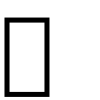
Question: (a) Convert the Cartesian equation x2+y2=4 to polar form. (b) Convert r=2cosθ to Cartesian form and sketch the curve. (c) Convert r=1+cosθ4 to Cartesian form. (d) Sketch r=2(1+cosθ) for 0≤θ≤2π.
(b) r=2cosθ⇒r2=2rcosθ⇒x2+y2=2x⇒(x−1)2+y2=1. This is a circle centred at (1,0) with radius 1. It passes through the origin and is tangent to the y-axis.
Question: (a) Find the area enclosed by one loop of r=sin2θ. (b) Find the area enclosed by r=2+cosθ. (c) Find the area enclosed by the cardioid r=1+cosθ. (d) Find the area inside r=3cosθ and outside r=1+cosθ.
Solution:
(a) One loop of r=sin2θ occurs for 0≤θ≤π/2. A=21∫0π/2sin22θdθ=21∫0π/221−cos4θdθ=41[θ−4sin4θ]0π/2=8π.
Question: (a) Find the equation of the tangent to r=2(1−cosθ) at θ=π/2. (b) Find the points where r=2 and r=4cosθ intersect. (c) Find the angle between the tangent and the radius vector at θ=π/4 for r=eθ. (d) Convert r=secθ to Cartesian form.
Question: The curve r=aθ (Archimedean spiral) for 0≤θ≤2π. (a) Find the arc length. (b) Find the area enclosed. (c) Find the Cartesian equation of the tangent at θ=π. (d) Find the area between the spiral and the line θ=π.
This requires the substitution θ=sinhu: d\theta = \cosh u\,du$$\sqrt{\theta^2+1} = \cosh u. s=a∫0arcsinh(2π)cosh2udu=2a∫0arcsinh(2π)(1+cosh2u)du=2a[u+2sinh2u].
Since sinh(arcsinh(2π))=2π and cosh(arcsinh(2π))=1+4π2: sinh(2arcsinh(2π))=2×2π×1+4π2=4π1+4π2. s=2a(arcsinh(2π)+2π1+4π2).
Question: The conic r=2+cosθ6 has eccentricity e and semi-latus rectum l. (a) Find e and l. (b) Identify the type of conic. (c) Find the Cartesian equation. (d) Find the directrices in Cartesian form.
Solution:
(a) Standard form: r=1+ecosθl. Given: r=2+cosθ6=1+21cosθ3. So l=3 and e=1/2.
This is still impossible. The error is in the sign: r+x/2=3 requires r=3−x/2. For r≥0 We need x≤6. But squaring introduces extraneous solutions. The equation should be written as 4y2+3(x−2)2=6 Giving an ellipse. Let me verify: y2+6=−43(x−2)2. That gives negative. I”ve made a sign error somewhere.
Actually: r=3−x/2 gives r2=(3−x/2)2=9−3x+x2/4. And r2=x2+y2. So x2+y2=9−3x+x2/4. 43x2+3x+y2−9=0. (Sign of 3x was wrong.)
43(x2+4x+4)+y2−9−3=0. 43(x+2)2+y2=12. This is an ellipse centred at (−2,0) with semi-axes a=4 and b=23.
(d) The directrix is x=l/e=3/(1/2)=6 I.e., x=6 in Cartesian form.
Question: A region is bounded by r=1+cosθ (cardioid) and r=3cosθ (circle). (a) Find the intersection angles. (b) Calculate the area of the region inside the circle but outside the cardioid. (c) Calculate the area of the region inside the cardioid but outside the circle. (d) Verify that the total area equals the area of the circle.
Solution:
(a) 1+cosθ=3cosθ. 1=2cosθ. cosθ=1/2. θ=±π/3.
(b) Area inside circle, outside cardioid (in the region θ∈[−π/3,π/3]): A=21∫−π/3π/3[(3cosθ)2−(1+cosθ)2]dθ=21∫−π/3π/3(9cos2θ−1−2cosθ−cos2θ)dθ=21∫−π/3π/3(8cos2θ−2cosθ−1)dθ=21∫−π/3π/3(4+4cos2θ−2cosθ−1)dθ=21∫−π/3π/3(3+4cos2θ−2cosθ)dθ=21[3θ+2sin2θ−2sinθ]−π/3π/3=21(2π)=π.
(c) Area inside cardioid but outside circle (the remaining part of the circle, θ∈[π/3,5π/3] — but the cardioid only goes to π And for θ∈[π/3,π] The circle is r=3cosθ which can be negative).
Actually, the area inside the cardioid minus the overlap with the circle: Total cardioid area =3π/2. Total circle area =9π/4 (from r=3cosθ Area =π(3/2)2/2=9π/8… Wait, area of circle r=acosθ: A=21∫−π/2π/2a2cos2θdθ=4πa2).
For a=3: circle area =9π/4.
Area inside cardioid, outside circle: 3π/2−π=π/2.
(d) Total: overlap (π) + inside cardioid outside circle (π/2) =3π/2 (cardioid area). The circle area is 9π/4=2.25π and cardioid area is 1.5π. The circle area exceeds the cardioid area, so the overlap plus outside-cardioid-in-circle should equal 9π/4. Outside cardioid, inside circle =9π/4−π=5π/4.
Forgetting the 21 in the polar area formula: The area enclosed by a polar curve is A=21∫r2dθ, not ∫r2dθ. The factor of 21 comes from the geometry of the sector area. Omitting it doubles the answer, a very common error.
Mixing up the conversion between polar and Cartesian:x=rcosθ, y=rsinθ, r2=x2+y2, tanθ=y/x. Students sometimes write r=xcosθ+ysinθ or confuse which functions go with which variable. Always derive from the right-angled triangle.
Using the wrong limits for polar integration: The limits must be angles θ, not distances r. When finding the area between two curves, identify the intersection angles by setting r1(θ)=r2(θ) and solving for θ. Do not use Cartesian x or y limits for polar integrals.