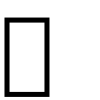
An acid is a proton (H + \mathrm{H}^+ H + base is a proton acceptor.
When an acid donates a proton, the remaining species is its conjugate base . When a base accepts a proton, the resulting species is its conjugate acid .
H A + H 2 O ⇌ H 3 O + + A − \mathrm{HA} + \mathrm{H}_2\mathrm{O} \rightleftharpoons \mathrm{H}_3\mathrm{O}^+ + \mathrm{A}^- HA + H 2 O ⇌ H 3 O + + A − H A \mathrm{HA} HA A − \mathrm{A}^- A − H 2 O \mathrm{H}_2\mathrm{O} H 2 O H 3 O + \mathrm{H}_3\mathrm{O}^+ H 3 O + A conjugate pair differs by a single proton. For example, N H 4 + / N H 3 \mathrm{NH}_4^+/\mathrm{NH}_3 NH 4 + / NH 3 H 2 O / O H − \mathrm{H}_2\mathrm{O}/\mathrm{OH}^- H 2 O / OH −
A Lewis acid is an electron pair acceptor. A Lewis base is an electron pair donor. This definition is broader than Bronsted-Lowry and includes reactions that do not involve proton transfer.
Example: B F 3 \mathrm{BF}_3 BF 3 p p p N H 3 \mathrm{NH}_3 NH 3
B F 3 + N H 3 → F 3 B − − N H 3 \mathrm{BF}_3 + \mathrm{NH}_3 \to \mathrm{F}_3\mathrm{B}\mathrm{--}\mathrm{NH}_3 BF 3 + NH 3 → F 3 B − − NH 3 A strong acid is completely dissociated in aqueous solution:
H C l ( a q ) → H + ( a q ) + C l − ( a q ) \mathrm{HCl}(aq) \to \mathrm{H}^+(aq) + \mathrm{Cl}^-(aq) HCl ( a q ) → H + ( a q ) + Cl − ( a q ) Common strong acids: \mathrm{HCl}$$\mathrm{HBr}$$\mathrm{HI}$$\mathrm{HNO}_3$$\mathrm{H}_2\mathrm{SO}_4 (first dissociation), H C l O 4 \mathrm{HClO}_4 HClO 4
For a strong monoprotic acid of concentration c c c [ H + ] = c [\mathrm{H}^+] = c [ H + ] = c
A weak acid is partially dissociated in aqueous solution:
H A ( a q ) ⇌ H + ( a q ) + A − ( a q ) \mathrm{HA}(aq) \rightleftharpoons \mathrm{H}^+(aq) + \mathrm{A}^-(aq) HA ( a q ) ⇌ H + ( a q ) + A − ( a q ) The position of equilibrium lies to the left. The degree of dissociation α \alpha α α ≪ 1 \alpha \ll 1 α ≪ 1
Common weak acids: \mathrm{CH}_3\mathrm{COOH}$$\mathrm{HCOOH}$$\mathrm{HCN}$$\mathrm{H}_2\mathrm{CO}_3$$\mathrm{NH}_4^+ .
Common strong bases: Group 1 hydroxides (\mathrm{NaOH}$$\mathrm{KOH} ), B a ( O H ) 2 \mathrm{Ba(OH)}_2 Ba ( OH ) 2 C a ( O H ) 2 \mathrm{Ca(OH)}_2 Ca ( OH ) 2
Common weak bases: N H 3 \mathrm{NH}_3 NH 3 \mathrm{CO}_3^{2-}$$\mathrm{HCO}_3^- .
The pH is defined as:
p H = − log 10 [ H + ] \mathrm{pH} = -\log_{10}[\mathrm{H}^+] pH = − log 10 [ H + ] Where [ H + ] [\mathrm{H}^+] [ H + ] m o l / d m 3 \mathrm{mol/dm}^3 mol/dm 3
At 25 ∘ C 25^\circ\mathrm{C} 2 5 ∘ C [ H + ] = 1.0 × 10 − 7 m o l / d m 3 [\mathrm{H}^+] = 1.0 \times 10^{-7}\,\mathrm{mol/dm}^3 [ H + ] = 1.0 × 1 0 − 7 mol/dm 3 p H = 7.0 \mathrm{pH} = 7.0 pH = 7.0 Acidic solutions: p H < 7 \mathrm{pH} \lt 7 pH < 7 [ H + ] > [ O H − ] [\mathrm{H}^+] \gt [\mathrm{OH}^-] [ H + ] > [ OH − ] Alkaline solutions: p H > 7 \mathrm{pH} \gt 7 pH > 7 [ H + ] < [ O H − ] [\mathrm{H}^+] \lt [\mathrm{OH}^-] [ H + ] < [ OH − ] pH is measured on a scale of 0—14, though values outside this range are possible. Water undergoes autoionisation:
2 H 2 O ( l ) ⇌ H 3 O + ( a q ) + O H − ( a q ) 2\mathrm{H}_2\mathrm{O}(l) \rightleftharpoons \mathrm{H}_3\mathrm{O}^+(aq) + \mathrm{OH}^-(aq) 2 H 2 O ( l ) ⇌ H 3 O + ( a q ) + OH − ( a q ) Simplified:
H 2 O ( l ) ⇌ H + ( a q ) + O H − ( a q ) \mathrm{H}_2\mathrm{O}(l) \rightleftharpoons \mathrm{H}^+(aq) + \mathrm{OH}^-(aq) H 2 O ( l ) ⇌ H + ( a q ) + OH − ( a q ) K w = [ H + ] [ O H − ] K_w = [\mathrm{H}^+][\mathrm{OH}^-] K w = [ H + ] [ OH − ] At 25 ∘ C 25^\circ\mathrm{C} 2 5 ∘ C K w = 1.0 × 10 − 14 m o l 2 d m − 6 K_w = 1.0 \times 10^{-14}\,\mathrm{mol^2\,dm^{-6}} K w = 1.0 × 1 0 − 14 mo l 2 d m − 6
Since [ H + ] = [ O H − ] [\mathrm{H}^+] = [\mathrm{OH}^-] [ H + ] = [ OH − ] [ H + ] = K w = 1.0 × 10 − 7 m o l / d m 3 [\mathrm{H}^+] = \sqrt{K_w} = 1.0 \times 10^{-7}\,\mathrm{mol/dm}^3 [ H + ] = K w = 1.0 × 1 0 − 7 mol/dm 3
K w K_w K w 50^\circ\mathrm{C}$$K_w = 5.5 \times 10^{-14} So neutral p H = 6.63 \mathrm{pH} = 6.63 pH = 6.63 [ H + ] = [ O H − ] [\mathrm{H}^+] = [\mathrm{OH}^-] [ H + ] = [ OH − ] K w K_w K w
For a weak acid H A \mathrm{HA} HA
H A ( a q ) ⇌ H + ( a q ) + A − ( a q ) \mathrm{HA}(aq) \rightleftharpoons \mathrm{H}^+(aq) + \mathrm{A}^-(aq) HA ( a q ) ⇌ H + ( a q ) + A − ( a q ) K a = [ H + ] [ A − ] [ H A ] K_a = \frac{[\mathrm{H}^+][\mathrm{A}^-]}{[\mathrm{HA}]} K a = [ HA ] [ H + ] [ A − ] Units of K a K_a K a m o l d m − 3 \mathrm{mol\,dm^{-3}} mol d m − 3
p K a = − log 10 K a \mathrm{p}K_a = -\log_{10} K_a p K a = − log 10 K a Lower p K a \mathrm{p}K_a p K a
Acid K a K_a K a m o l / d m 3 \mathrm{mol/dm}^3 mol/dm 3 p K a \mathrm{p}K_a p K a C H 3 C O O H \mathrm{CH}_3\mathrm{COOH} CH 3 COOH 1.74 × 10 − 5 1.74 \times 10^{-5} 1.74 × 1 0 − 5 4.76 H C O O H \mathrm{HCOOH} HCOOH 1.78 × 10 − 4 1.78 \times 10^{-4} 1.78 × 1 0 − 4 3.75 H C N \mathrm{HCN} HCN 6.2 × 10 − 10 6.2 \times 10^{-10} 6.2 × 1 0 − 10 9.21 H F \mathrm{HF} HF 6.3 × 10 − 4 6.3 \times 10^{-4} 6.3 × 1 0 − 4 3.20
For a weak base B \mathrm{B} B
B ( a q ) + H 2 O ( l ) ⇌ B H + ( a q ) + O H − ( a q ) \mathrm{B}(aq) + \mathrm{H}_2\mathrm{O}(l) \rightleftharpoons \mathrm{BH}^+(aq) + \mathrm{OH}^-(aq) B ( a q ) + H 2 O ( l ) ⇌ BH + ( a q ) + OH − ( a q ) K b = [ B H + ] [ O H − ] [ B ] K_b = \frac{[\mathrm{BH}^+][\mathrm{OH}^-]}{[\mathrm{B}]} K b = [ B ] [ BH + ] [ OH − ] The relationship between K a K_a K a K b K_b K b
K a × K b = K w K_a \times K_b = K_w K a × K b = K w p K a + p K b = p K w = 14.00 ( a t 25 ∘ C ) \mathrm{p}K_a + \mathrm{p}K_b = \mathrm{p}K_w = 14.00\ (\mathrm{at } 25^\circ\mathrm{C}) p K a + p K b = p K w = 14.00 ( at 2 5 ∘ C ) For a strong monoprotic acid of concentration c c c
[ H + ] = c [\mathrm{H}^+] = c [ H + ] = c p H = − log 10 c \mathrm{pH} = -\log_{10} c pH = − log 10 c Example. 0.050 m o l / d m 3 0.050\,\mathrm{mol/dm}^3 0.050 mol/dm 3 H C l \mathrm{HCl} HCl p H = − log 10 ( 0.050 ) = 1.30 \mathrm{pH} = -\log_{10}(0.050) = 1.30 pH = − log 10 ( 0.050 ) = 1.30
For a strong base M O H \mathrm{MOH} MOH c c c
[ O H − ] = c [\mathrm{OH}^-] = c [ OH − ] = c [ H + ] = K w [ O H − ] = 1.0 × 10 − 14 c [\mathrm{H}^+] = \frac{K_w}{[\mathrm{OH}^-]} = \frac{1.0 \times 10^{-14}}{c} [ H + ] = [ OH − ] K w = c 1.0 × 1 0 − 14 p H = 14 + log 10 c \mathrm{pH} = 14 + \log_{10} c pH = 14 + log 10 c Example. 0.020 m o l / d m 3 0.020\,\mathrm{mol/dm}^3 0.020 mol/dm 3 N a O H \mathrm{NaOH} NaOH p H = 14 + log 10 ( 0.020 ) = 14 − 1.70 = 12.30 \mathrm{pH} = 14 + \log_{10}(0.020) = 14 - 1.70 = 12.30 pH = 14 + log 10 ( 0.020 ) = 14 − 1.70 = 12.30
For a weak acid H A \mathrm{HA} HA c c c K a K_a K a
K a = [ H + ] [ A − ] [ H A ] K_a = \frac{[\mathrm{H}^+][\mathrm{A}^-]}{[\mathrm{HA}]} K a = [ HA ] [ H + ] [ A − ] Assuming [ H + ] ≈ [ A − ] [\mathrm{H}^+] \approx [\mathrm{A}^-] [ H + ] ≈ [ A − ] [ H A ] ≈ c [\mathrm{HA}] \approx c [ HA ] ≈ c α < 5 % \alpha \lt 5\% α < 5%
K a = [ H + ] 2 c K_a = \frac{[\mathrm{H}^+]^2}{c} K a = c [ H + ] 2 [ H + ] = K a × c [\mathrm{H}^+] = \sqrt{K_a \times c} [ H + ] = K a × c p H = − log 10 K a c = 1 2 ( p K a − log 10 c ) \mathrm{pH} = -\log_{10}\sqrt{K_a c} = \frac{1}{2}(\mathrm{p}K_a - \log_{10} c) pH = − log 10 K a c = 2 1 ( p K a − log 10 c ) Worked Example. Calculate the pH of 0.100 m o l / d m 3 0.100\,\mathrm{mol/dm}^3 0.100 mol/dm 3 K a = 1.74 × 10 − 5 K_a = 1.74 \times 10^{-5} K a = 1.74 × 1 0 − 5
[ H + ] = 1.74 × 10 − 5 × 0.100 = 1.74 × 10 − 6 = 1.32 × 10 − 3 m o l / d m 3 [\mathrm{H}^+] = \sqrt{1.74 \times 10^{-5} \times 0.100} = \sqrt{1.74 \times 10^{-6}} = 1.32 \times 10^{-3}\,\mathrm{mol/dm}^3 [ H + ] = 1.74 × 1 0 − 5 × 0.100 = 1.74 × 1 0 − 6 = 1.32 × 1 0 − 3 mol/dm 3 p H = − log 10 ( 1.32 × 10 − 3 ) = 2.88 \mathrm{pH} = -\log_{10}(1.32 \times 10^{-3}) = 2.88 pH = − log 10 ( 1.32 × 1 0 − 3 ) = 2.88 Verification: α = 1.32 × 10 − 3 / 0.100 = 1.32 % < 5 % \alpha = 1.32 \times 10^{-3} / 0.100 = 1.32\% \lt 5\% α = 1.32 × 1 0 − 3 /0.100 = 1.32% < 5%
For a weak base B \mathrm{B} B c c c K b K_b K b
[ O H − ] = K b × c [\mathrm{OH}^-] = \sqrt{K_b \times c} [ OH − ] = K b × c p O H = − log 10 [ O H − ] \mathrm{pOH} = -\log_{10}[\mathrm{OH}^-] pOH = − log 10 [ OH − ] p H = 14 − p O H \mathrm{pH} = 14 - \mathrm{pOH} pH = 14 − pOH Example. Calculate the pH of 0.200 m o l / d m 3 0.200\,\mathrm{mol/dm}^3 0.200 mol/dm 3 N H 3 \mathrm{NH}_3 NH 3 K b = 1.78 × 10 − 5 K_b = 1.78 \times 10^{-5} K b = 1.78 × 1 0 − 5
[ O H − ] = 1.78 × 10 − 5 × 0.200 = 3.56 × 10 − 6 = 1.89 × 10 − 3 m o l / d m 3 [\mathrm{OH}^-] = \sqrt{1.78 \times 10^{-5} \times 0.200} = \sqrt{3.56 \times 10^{-6}} = 1.89 \times 10^{-3}\,\mathrm{mol/dm}^3 [ OH − ] = 1.78 × 1 0 − 5 × 0.200 = 3.56 × 1 0 − 6 = 1.89 × 1 0 − 3 mol/dm 3 p O H = − log 10 ( 1.89 × 10 − 3 ) = 2.72 \mathrm{pOH} = -\log_{10}(1.89 \times 10^{-3}) = 2.72 pOH = − log 10 ( 1.89 × 1 0 − 3 ) = 2.72 p H = 14 − 2.72 = 11.28 \mathrm{pH} = 14 - 2.72 = 11.28 pH = 14 − 2.72 = 11.28 A buffer solution resists changes in pH when small amounts of acid or base are added. An acidic buffer consists of:
A weak acid (H A \mathrm{HA} HA Its conjugate base (A − \mathrm{A}^- A − C H 3 C O O H + C H 3 C O O N a \mathrm{CH}_3\mathrm{COOH} + \mathrm{CH}_3\mathrm{COONa} CH 3 COOH + CH 3 COONa A basic buffer consists of a weak base and its conjugate acid (e.g. N H 3 + N H 4 C l \mathrm{NH}_3 + \mathrm{NH}_4\mathrm{Cl} NH 3 + NH 4 Cl
Adding acid (H + \mathrm{H}^+ H + The conjugate base A − \mathrm{A}^- A − H + \mathrm{H}^+ H +
A − + H + → H A \mathrm{A}^- + \mathrm{H}^+ \to \mathrm{HA} A − + H + → HA This consumes the added H + \mathrm{H}^+ H +
Adding base (O H − \mathrm{OH}^- OH − The weak acid H A \mathrm{HA} HA O H − \mathrm{OH}^- OH −
H A + O H − → A − + H 2 O \mathrm{HA} + \mathrm{OH}^- \to \mathrm{A}^- + \mathrm{H}_2\mathrm{O} HA + OH − → A − + H 2 O This consumes the added O H − \mathrm{OH}^- OH −
Starting from the K a K_a K a
K a = [ H + ] [ A − ] [ H A ] K_a = \frac{[\mathrm{H}^+][\mathrm{A}^-]}{[\mathrm{HA}]} K a = [ HA ] [ H + ] [ A − ] Rearranging:
[ H + ] = K a × [ H A ] [ A − ] [\mathrm{H}^+] = K_a \times \frac{[\mathrm{HA}]}{[\mathrm{A}^-]} [ H + ] = K a × [ A − ] [ HA ] Taking − log 10 -\log_{10} − log 10
p H = p K a + log 10 [ A − ] [ H A ] \mathrm{pH} = \mathrm{p}K_a + \log_{10}\frac{[\mathrm{A}^-]}{[\mathrm{HA}]} pH = p K a + log 10 [ HA ] [ A − ] This is the Henderson-Hasselbalch equation .
Key points:
When [ A − ] = [ H A ] [\mathrm{A}^-] = [\mathrm{HA}] [ A − ] = [ HA ] p H = p K a \mathrm{pH} = \mathrm{p}K_a pH = p K a The buffer is most effective when p H ≈ p K a \mathrm{pH} \approx \mathrm{p}K_a pH ≈ p K a ± 1 \pm 1 ± 1 Buffer capacity depends on the absolute concentrations of H A \mathrm{HA} HA A − \mathrm{A}^- A − Worked Example. Calculate the pH of a buffer containing 0.100 m o l / d m 3 0.100\,\mathrm{mol/dm}^3 0.100 mol/dm 3 C H 3 C O O H \mathrm{CH}_3\mathrm{COOH} CH 3 COOH 0.150 m o l / d m 3 0.150\,\mathrm{mol/dm}^3 0.150 mol/dm 3 C H 3 C O O N a \mathrm{CH}_3\mathrm{COONa} CH 3 COONa p K a = 4.76 \mathrm{p}K_a = 4.76 p K a = 4.76
p H = 4.76 + log 10 ( 0.150 0.100 ) = 4.76 + 0.176 = 4.94 \mathrm{pH} = 4.76 + \log_{10}\left(\frac{0.150}{0.100}\right) = 4.76 + 0.176 = 4.94 pH = 4.76 + log 10 ( 0.100 0.150 ) = 4.76 + 0.176 = 4.94 Example: H C l \mathrm{HCl} HCl N a O H \mathrm{NaOH} NaOH
Initial pH: low (≈ 1 \approx 1 ≈ 1 0.1 m o l / d m 3 0.1\,\mathrm{mol/dm}^3 0.1 mol/dm 3 H C l \mathrm{HCl} HCl pH rises slowly, then very steeply near the equivalence point. Equivalence point at p H = 7.0 \mathrm{pH} = 7.0 pH = 7.0 The pH jump is large ( 3—11), allowing a wide choice of indicators. Example: H C l \mathrm{HCl} HCl N H 3 \mathrm{NH}_3 NH 3
Equivalence point at p H < 7 \mathrm{pH} \lt 7 pH < 7 N H 4 + \mathrm{NH}_4^+ NH 4 + Suitable indicator: methyl orange (range 3.1—4.4). Example: C H 3 C O O H \mathrm{CH}_3\mathrm{COOH} CH 3 COOH N a O H \mathrm{NaOH} NaOH
Equivalence point at p H > 7 \mathrm{pH} \gt 7 pH > 7 C H 3 C O O − \mathrm{CH}_3\mathrm{COO}^- CH 3 COO − Suitable indicator: phenolphthalein (range 8.3—10.0). Half-equivalence point: At half-neutralisation, [ H A ] = [ A − ] [\mathrm{HA}] = [\mathrm{A}^-] [ HA ] = [ A − ] p H = p K a \mathrm{pH} = \mathrm{p}K_a pH = p K a p K a \mathrm{p}K_a p K a
Example: C H 3 C O O H \mathrm{CH}_3\mathrm{COOH} CH 3 COOH N H 3 \mathrm{NH}_3 NH 3
No sharp equivalence point. The pH change is gradual, making it difficult to select an appropriate indicator. A pH meter is required for accurate endpoint determination. Titration type Equivalence point pH Suitable indicator Strong acid / Strong base 7.0 Any (e.g. Bromothymol blue) Strong acid / Weak base < 7.0 Methyl orange (3.1—4.4) Weak acid / Strong base > 7.0 Phenolphthalein (8.3—10.0) Weak acid / Weak base ≈ 7.0 \approx 7.0 ≈ 7.0 None suitable; use pH meter
The standard enthalpy of neutralisation is the enthalpy change when one mole of water is formed from the reaction of an acid and a base under standard conditions.
H + ( a q ) + O H − ( a q ) → H 2 O ( l ) Δ H = − 57.1 k J / m o l \mathrm{H}^+(aq) + \mathrm{OH}^-(aq) \to \mathrm{H}_2\mathrm{O}(l) \quad \Delta H = -57.1\,\mathrm{kJ/mol} H + ( a q ) + OH − ( a q ) → H 2 O ( l ) Δ H = − 57.1 kJ/mol This value is approximately constant for strong acid-strong base reactions because the net ionic equation is always the same.
For reactions involving weak acids or weak bases, the enthalpy of neutralisation is less exothermic (e.g. − 51 -51 − 51 − 55 k J / m o l -55\,\mathrm{kJ/mol} − 55 kJ/mol
Confusing pH with [H+]. pH = 3 does not mean [ H + ] = 3 m o l / d m 3 [\mathrm{H}^+] = 3\,\mathrm{mol/dm}^3 [ H + ] = 3 mol/dm 3 [ H + ] = 10 − 3 m o l / d m 3 [\mathrm{H}^+] = 10^{-3}\,\mathrm{mol/dm}^3 [ H + ] = 1 0 − 3 mol/dm 3 [ H + ] [\mathrm{H}^+] [ H + ]
Applying the weak acid approximation when it is not valid. If c / K a < 100 c/K_a \lt 100 c / K a < 100 [ H A ] ≈ c [\mathrm{HA}] \approx c [ HA ] ≈ c
Using the wrong indicator. The indicator range must overlap with the steep portion of the titration curve at the equivalence point.
Forgetting that K w K_w K w At temperatures other than 25^\circ\mathrm{C}$$\mathrm{p}K_w \ne 14 So p H + p O H ≠ 14 \mathrm{pH} + \mathrm{pOH} \ne 14 pH + pOH = 14
Adding strong acid/base to a buffer in quantities exceeding its capacity. The buffer can only resist small additions; large additions will overwhelm it.
Problem 1 Calculate the pH of a solution formed by mixing 25.0 c m 3 25.0\,\mathrm{cm}^3 25.0 cm 3 0.100 m o l / d m 3 0.100\,\mathrm{mol/dm}^3 0.100 mol/dm 3 C H 3 C O O H \mathrm{CH}_3\mathrm{COOH} CH 3 COOH p K a = 4.76 \mathrm{p}K_a = 4.76 p K a = 4.76 10.0 c m 3 10.0\,\mathrm{cm}^3 10.0 cm 3 0.100 m o l / d m 3 0.100\,\mathrm{mol/dm}^3 0.100 mol/dm 3 N a O H \mathrm{NaOH} NaOH
Solution:
n ( C H 3 C O O H ) = 0.100 × 0.0250 = 2.50 × 10 − 3 m o l n(\mathrm{CH}_3\mathrm{COOH}) = 0.100 \times 0.0250 = 2.50 \times 10^{-3}\,\mathrm{mol} n ( CH 3 COOH ) = 0.100 × 0.0250 = 2.50 × 1 0 − 3 mol
n ( N a O H ) = 0.100 × 0.0100 = 1.00 × 10 − 3 m o l n(\mathrm{NaOH}) = 0.100 \times 0.0100 = 1.00 \times 10^{-3}\,\mathrm{mol} n ( NaOH ) = 0.100 × 0.0100 = 1.00 × 1 0 − 3 mol
N a O H \mathrm{NaOH} NaOH
n ( C H 3 C O O H ) = 2.50 × 10 − 3 − 1.00 × 10 − 3 = 1.50 × 10 − 3 m o l n(\mathrm{CH}_3\mathrm{COOH}) = 2.50 \times 10^{-3} - 1.00 \times 10^{-3} = 1.50 \times 10^{-3}\,\mathrm{mol} n ( CH 3 COOH ) = 2.50 × 1 0 − 3 − 1.00 × 1 0 − 3 = 1.50 × 1 0 − 3 mol
n ( C H 3 C O O − ) = 1.00 × 10 − 3 m o l n(\mathrm{CH}_3\mathrm{COO}^-) = 1.00 \times 10^{-3}\,\mathrm{mol} n ( CH 3 COO − ) = 1.00 × 1 0 − 3 mol
Total volume = 35.0 c m 3 35.0\,\mathrm{cm}^3 35.0 cm 3
[ C H 3 C O O H ] = 1.50 × 10 − 3 / 0.0350 = 0.0429 m o l / d m 3 [\mathrm{CH}_3\mathrm{COOH}] = 1.50 \times 10^{-3} / 0.0350 = 0.0429\,\mathrm{mol/dm}^3 [ CH 3 COOH ] = 1.50 × 1 0 − 3 /0.0350 = 0.0429 mol/dm 3
[ C H 3 C O O − ] = 1.00 × 10 − 3 / 0.0350 = 0.0286 m o l / d m 3 [\mathrm{CH}_3\mathrm{COO}^-] = 1.00 \times 10^{-3} / 0.0350 = 0.0286\,\mathrm{mol/dm}^3 [ CH 3 COO − ] = 1.00 × 1 0 − 3 /0.0350 = 0.0286 mol/dm 3
p H = 4.76 + log 10 ( 0.0286 0.0429 ) = 4.76 − 0.176 = 4.58 \mathrm{pH} = 4.76 + \log_{10}\left(\frac{0.0286}{0.0429}\right) = 4.76 - 0.176 = 4.58 pH = 4.76 + log 10 ( 0.0429 0.0286 ) = 4.76 − 0.176 = 4.58 Problem 2 The pH of a 0.050 m o l / d m 3 0.050\,\mathrm{mol/dm}^3 0.050 mol/dm 3 H X \mathrm{HX} HX K a K_a K a p K a \mathrm{p}K_a p K a
Solution:
[ H + ] = 10 − 3.00 = 1.00 × 10 − 3 m o l / d m 3 [\mathrm{H}^+] = 10^{-3.00} = 1.00 \times 10^{-3}\,\mathrm{mol/dm}^3 [ H + ] = 1 0 − 3.00 = 1.00 × 1 0 − 3 mol/dm 3 K a = [ H + ] 2 c = ( 1.00 × 10 − 3 ) 2 0.050 = 1.00 × 10 − 6 0.050 = 2.0 × 10 − 5 m o l / d m 3 K_a = \frac{[\mathrm{H}^+]^2}{c} = \frac{(1.00 \times 10^{-3})^2}{0.050} = \frac{1.00 \times 10^{-6}}{0.050} = 2.0 \times 10^{-5}\,\mathrm{mol/dm}^3 K a = c [ H + ] 2 = 0.050 ( 1.00 × 1 0 − 3 ) 2 = 0.050 1.00 × 1 0 − 6 = 2.0 × 1 0 − 5 mol/dm 3 p K a = − log 10 ( 2.0 × 10 − 5 ) = 4.70 \mathrm{p}K_a = -\log_{10}(2.0 \times 10^{-5}) = 4.70 p K a = − log 10 ( 2.0 × 1 0 − 5 ) = 4.70 Problem 3 A buffer solution is prepared by adding 50.0 c m 3 50.0\,\mathrm{cm}^3 50.0 cm 3 0.200 m o l / d m 3 0.200\,\mathrm{mol/dm}^3 0.200 mol/dm 3 N a O H \mathrm{NaOH} NaOH 100 c m 3 100\,\mathrm{cm}^3 100 cm 3 0.200 m o l / d m 3 0.200\,\mathrm{mol/dm}^3 0.200 mol/dm 3 C H 3 C O O H \mathrm{CH}_3\mathrm{COOH} CH 3 COOH p K a = 4.76 \mathrm{p}K_a = 4.76 p K a = 4.76 5.0 c m 3 5.0\,\mathrm{cm}^3 5.0 cm 3 0.100 m o l / d m 3 0.100\,\mathrm{mol/dm}^3 0.100 mol/dm 3 H C l \mathrm{HCl} HCl 25.0 c m 3 25.0\,\mathrm{cm}^3 25.0 cm 3
Solution:
Part 1: Buffer pH
n ( C H 3 C O O H ) i n i t i a l = 0.200 × 0.100 = 0.0200 m o l n(\mathrm{CH}_3\mathrm{COOH})_\mathrm{initial} = 0.200 \times 0.100 = 0.0200\,\mathrm{mol} n ( CH 3 COOH ) initial = 0.200 × 0.100 = 0.0200 mol
n ( N a O H ) = 0.200 × 0.0500 = 0.0100 m o l n(\mathrm{NaOH}) = 0.200 \times 0.0500 = 0.0100\,\mathrm{mol} n ( NaOH ) = 0.200 × 0.0500 = 0.0100 mol
After reaction: n ( C H 3 C O O H ) = 0.0200 − 0.0100 = 0.0100 m o l n(\mathrm{CH}_3\mathrm{COOH}) = 0.0200 - 0.0100 = 0.0100\,\mathrm{mol} n ( CH 3 COOH ) = 0.0200 − 0.0100 = 0.0100 mol
n ( C H 3 C O O − ) = 0.0100 m o l n(\mathrm{CH}_3\mathrm{COO}^-) = 0.0100\,\mathrm{mol} n ( CH 3 COO − ) = 0.0100 mol
Total volume = 150 c m 3 = 0.150 d m 3 150\,\mathrm{cm}^3 = 0.150\,\mathrm{dm}^3 150 cm 3 = 0.150 dm 3
[ C H 3 C O O H ] = 0.0100 / 0.150 = 0.0667 m o l / d m 3 [\mathrm{CH}_3\mathrm{COOH}] = 0.0100/0.150 = 0.0667\,\mathrm{mol/dm}^3 [ CH 3 COOH ] = 0.0100/0.150 = 0.0667 mol/dm 3
[ C H 3 C O O − ] = 0.0100 / 0.150 = 0.0667 m o l / d m 3 [\mathrm{CH}_3\mathrm{COO}^-] = 0.0100/0.150 = 0.0667\,\mathrm{mol/dm}^3 [ CH 3 COO − ] = 0.0100/0.150 = 0.0667 mol/dm 3
p H = 4.76 + log 10 ( 0.0667 0.0667 ) = 4.76 + log 10 ( 1 ) = 4.76 + 0 = 4.76 \mathrm{pH} = 4.76 + \log_{10}\left(\frac{0.0667}{0.0667}\right) = 4.76 + \log_{10}(1) = 4.76 + 0 = 4.76 pH = 4.76 + log 10 ( 0.0667 0.0667 ) = 4.76 + log 10 ( 1 ) = 4.76 + 0 = 4.76 The buffer pH equals the p K a \mathrm{p}K_a p K a [ a c i d ] = [ s a l t ] [\mathrm{acid}] = [\mathrm{salt}] [ acid ] = [ salt ]
Part 2: pH change on adding H C l \mathrm{HCl} HCl
n ( H C l ) = 0.100 × 0.0050 = 5.0 × 10 − 4 m o l n(\mathrm{HCl}) = 0.100 \times 0.0050 = 5.0 \times 10^{-4}\,\mathrm{mol} n ( HCl ) = 0.100 × 0.0050 = 5.0 × 1 0 − 4 mol
The added H + \mathrm{H}^+ H + C H 3 C O O − \mathrm{CH}_3\mathrm{COO}^- CH 3 COO −
n ( C H 3 C O O − ) n(\mathrm{CH}_3\mathrm{COO}^-) n ( CH 3 COO − ) 0.0667 × 0.0250 − 5.0 × 10 − 4 = 1.668 × 10 − 3 − 5.0 × 10 − 4 = 1.168 × 10 − 3 m o l 0.0667 \times 0.0250 - 5.0 \times 10^{-4} = 1.668 \times 10^{-3} - 5.0 \times 10^{-4} = 1.168 \times 10^{-3}\,\mathrm{mol} 0.0667 × 0.0250 − 5.0 × 1 0 − 4 = 1.668 × 1 0 − 3 − 5.0 × 1 0 − 4 = 1.168 × 1 0 − 3 mol
n ( C H 3 C O O H ) n(\mathrm{CH}_3\mathrm{COOH}) n ( CH 3 COOH ) 0.0667 × 0.0250 + 5.0 × 10 − 4 = 1.668 × 10 − 3 + 5.0 × 10 − 4 = 2.168 × 10 − 3 m o l 0.0667 \times 0.0250 + 5.0 \times 10^{-4} = 1.668 \times 10^{-3} + 5.0 \times 10^{-4} = 2.168 \times 10^{-3}\,\mathrm{mol} 0.0667 × 0.0250 + 5.0 × 1 0 − 4 = 1.668 × 1 0 − 3 + 5.0 × 1 0 − 4 = 2.168 × 1 0 − 3 mol
Volume = 25.0 + 5.0 = 30.0 c m 3 = 0.0300 d m 3 25.0 + 5.0 = 30.0\,\mathrm{cm}^3 = 0.0300\,\mathrm{dm}^3 25.0 + 5.0 = 30.0 cm 3 = 0.0300 dm 3
[ C H 3 C O O H ] = 2.168 × 10 − 3 / 0.0300 = 0.0723 m o l / d m 3 [\mathrm{CH}_3\mathrm{COOH}] = 2.168 \times 10^{-3}/0.0300 = 0.0723\,\mathrm{mol/dm}^3 [ CH 3 COOH ] = 2.168 × 1 0 − 3 /0.0300 = 0.0723 mol/dm 3
[ C H 3 C O O − ] = 1.168 × 10 − 3 / 0.0300 = 0.0389 m o l / d m 3 [\mathrm{CH}_3\mathrm{COO}^-] = 1.168 \times 10^{-3}/0.0300 = 0.0389\,\mathrm{mol/dm}^3 [ CH 3 COO − ] = 1.168 × 1 0 − 3 /0.0300 = 0.0389 mol/dm 3
p H = 4.76 + log 10 ( 0.0389 0.0723 ) = 4.76 − 0.269 = 4.49 \mathrm{pH} = 4.76 + \log_{10}\left(\frac{0.0389}{0.0723}\right) = 4.76 - 0.269 = 4.49 pH = 4.76 + log 10 ( 0.0723 0.0389 ) = 4.76 − 0.269 = 4.49 PH change = 4.76 − 4.49 = 0.27 4.76 - 4.49 = 0.27 4.76 − 4.49 = 0.27
For comparison, adding the same amount of H C l \mathrm{HCl} HCl 25.0 c m 3 25.0\,\mathrm{cm}^3 25.0 cm 3
[\mathrm{H}^+] = 5.0 \times 10^{-4} / 0.0300 = 0.0167\,\mathrm{mol/dm}^3$$\mathrm{pH} = 1.78
A change from pH 7.00 to pH 1.78 — 5.22 units. The buffer reduces the pH change by a factor of approximately 19.
Problem 4 Explain why the pH at the half-equivalence point of a weak acid-strong base titration equals the p K a \mathrm{p}K_a p K a
Solution:
At the half-equivalence point, exactly half the weak acid has been neutralised by the strong base:
H A + O H − → A − + H 2 O \mathrm{HA} + \mathrm{OH}^- \to \mathrm{A}^- + \mathrm{H}_2\mathrm{O} HA + OH − → A − + H 2 O If the initial amount of H A \mathrm{HA} HA n 0 n_0 n 0
n ( H A ) r e m a i n i n g = n 0 / 2 n(\mathrm{HA})_\mathrm{remaining} = n_0/2 n ( HA ) remaining = n 0 /2
n ( A − ) _ f o r m e d = n 0 / 2 n(\mathrm{A}^-)\_\mathrm{formed} = n_0/2 n ( A − ) _ formed = n 0 /2
Therefore [ H A ] = [ A − ] [\mathrm{HA}] = [\mathrm{A}^-] [ HA ] = [ A − ] 1 : 1 1:1 1 : 1
Applying the Henderson-Hasselbalch equation:
p H = p K a + log 10 ( [ A − ] [ H A ] ) = p K a + log 10 ( 1 ) = p K a + 0 = p K a \mathrm{pH} = \mathrm{p}K_a + \log_{10}\left(\frac{[\mathrm{A}^-]}{[\mathrm{HA}]}\right) = \mathrm{p}K_a + \log_{10}(1) = \mathrm{p}K_a + 0 = \mathrm{p}K_a pH = p K a + log 10 ( [ HA ] [ A − ] ) = p K a + log 10 ( 1 ) = p K a + 0 = p K a This is a useful experimental method for determining the p K a \mathrm{p}K_a p K a
An acid-base indicator is a weak acid that has a different colour from its conjugate base. The colour change occurs over a specific pH range ( about 2 pH units wide).
Indicator Colour in acid Colour in alkali pH range Methyl orange Red Yellow 3.1—4.4 Bromothymol blue Yellow Blue 6.0—7.6 Phenolphthalein Colourless Pink 8.2—10.0 Universal indicator Red/orange Green/blue/purple 1—14 (multiple colours)
The indicator must change colour at the pH of the equivalence point:
Titration type Equivalence point pH Suitable indicator Strong acid vs strong base p H = 7 \mathrm{pH} = 7 pH = 7 Bromothymol blue, phenol red Strong acid vs weak base p H < 7 \mathrm{pH} \lt 7 pH < 7 Molecular orange, bromophenol blue Weak acid vs strong base p H > 7 \mathrm{pH} \gt 7 pH > 7 Phenolphthalein
Strong acid-strong base (e.g. H C l \mathrm{HCl} HCl N a O H \mathrm{NaOH} NaOH
Initial pH is low (e.g. PH 1 for 0.1 m o l / d m 3 0.1\,\mathrm{mol/dm}^3 0.1 mol/dm 3 H C l \mathrm{HCl} HCl pH rises slowly at first, then very steeply near the equivalence point. The equivalence point is at pH 7 (neutral, because neither cation nor anion hydrolyses appreciably in water). The vertical portion of the curve is very steep (pH jumps from approximately 3 to 11 over a very small volume), allowing a wide choice of indicators. Weak acid-strong base (e.g. C H 3 C O O H \mathrm{CH}_3\mathrm{COOH} CH 3 COOH N a O H \mathrm{NaOH} NaOH
Initial pH is higher than for a strong acid of the same concentration (e.g. PH 2.9 for 0.1 m o l / d m 3 0.1\,\mathrm{mol/dm}^3 0.1 mol/dm 3 C H 3 C O O H \mathrm{CH}_3\mathrm{COOH} CH 3 COOH The initial rise is more gradual (buffer region). The equivalence point is at p H > 7 \mathrm{pH} \gt 7 pH > 7 C H 3 C O O − \mathrm{CH}_3\mathrm{COO}^- CH 3 COO − Phenolphthalein is the appropriate indicator. Strong acid-weak base (e.g. H C l \mathrm{HCl} HCl N H 3 \mathrm{NH}_3 NH 3
The equivalence point is at p H < 7 \mathrm{pH} \lt 7 pH < 7 N H 4 + \mathrm{NH}_4^+ NH 4 + Methyl orange is the appropriate indicator. Weak acid-weak base:
No sharp equivalence point; the pH change is gradual throughout. No single indicator is suitable; a pH meter must be used. In a weak acid-strong base titration, the buffer region is the flat portion of the curve before the equivalence point. In this region, added base converts H A \mathrm{HA} HA A − \mathrm{A}^- A − p H = p K a \mathrm{pH} = \mathrm{p}K_a pH = p K a
Strong monoprotic acid:
[ H + ] = c 0 ⟹ p H = − log 10 ( c 0 ) [\mathrm{H}^+] = c_0 \implies \mathrm{pH} = -\log_{10}(c_0) [ H + ] = c 0 ⟹ pH = − log 10 ( c 0 ) Strong diprotic acid (e.g. H 2 S O 4 \mathrm{H}_2\mathrm{SO}_4 H 2 SO 4
[ H + ] = 2 c 0 ⟹ p H = − log 10 ( 2 c 0 ) [\mathrm{H}^+] = 2c_0 \implies \mathrm{pH} = -\log_{10}(2c_0) [ H + ] = 2 c 0 ⟹ pH = − log 10 ( 2 c 0 ) Strong base:
[ O H − ] = c 0 ⟹ p O H = − log 10 ( c 0 ) ⟹ p H = 14 − p O H [\mathrm{OH}^-] = c_0 \implies \mathrm{pOH} = -\log_{10}(c_0) \implies \mathrm{pH} = 14 - \mathrm{pOH} [ OH − ] = c 0 ⟹ pOH = − log 10 ( c 0 ) ⟹ pH = 14 − pOH Worked Example. Calculate the pH of 0.050 m o l / d m 3 0.050\,\mathrm{mol/dm}^3 0.050 mol/dm 3 H 2 S O 4 \mathrm{H}_2\mathrm{SO}_4 H 2 SO 4
[ H + ] = 2 × 0.050 = 0.100 m o l / d m 3 [\mathrm{H}^+] = 2 \times 0.050 = 0.100\,\mathrm{mol/dm}^3 [ H + ] = 2 × 0.050 = 0.100 mol/dm 3 p H = − log 10 ( 0.100 ) = 1.00 \mathrm{pH} = -\log_{10}(0.100) = 1.00 pH = − log 10 ( 0.100 ) = 1.00 For a weak acid H A \mathrm{HA} HA
H A ⇌ H + + A − \mathrm{HA} \rightleftharpoons \mathrm{H}^+ + \mathrm{A}^- HA ⇌ H + + A − K a = [ H + ] [ A − ] [ H A ] K_a = \frac{[\mathrm{H}^+][\mathrm{A}^-]}{[\mathrm{HA}]} K a = [ HA ] [ H + ] [ A − ] If the acid is weak enough that [ H + ] = [ A − ] ≪ c 0 [\mathrm{H}^+] = [\mathrm{A}^-] \ll c_0 [ H + ] = [ A − ] ≪ c 0
K a ≈ [ H + ] 2 c 0 K_a \approx \frac{[\mathrm{H}^+]^2}{c_0} K a ≈ c 0 [ H + ] 2 [ H + ] = K a c 0 [\mathrm{H}^+] = \sqrt{K_a c_0} [ H + ] = K a c 0 p H = 1 2 ( p K a − log 10 c 0 ) \mathrm{pH} = \frac{1}{2}(\mathrm{p}K_a - \log_{10} c_0) pH = 2 1 ( p K a − log 10 c 0 ) Worked Example. Calculate the pH of 0.100 m o l / d m 3 0.100\,\mathrm{mol/dm}^3 0.100 mol/dm 3 K a = 1.74 × 10 − 5 m o l / d m 3 K_a = 1.74 \times 10^{-5}\,\mathrm{mol/dm}^3 K a = 1.74 × 1 0 − 5 mol/dm 3
[\mathrm{H}^+] = \sqrt{1.74 \times 10^{-5} \times 0.100} = \sqrt{1.74 \times 10^{-6}} = 1.32 \times 10^{-3}\,\mathrm{mol/dm}^3} p H = − log 10 ( 1.32 × 10 − 3 ) = 2.88 \mathrm{pH} = -\log_{10}(1.32 \times 10^{-3}) = 2.88 pH = − log 10 ( 1.32 × 1 0 − 3 ) = 2.88 Note that 1.32 × 10 − 3 1.32 \times 10^{-3} 1.32 × 1 0 − 3 1.3 % 1.3\% 1.3% 0.100 0.100 0.100
K a = x 2 c 0 − x ⟹ x 2 + K a x − K a c 0 = 0 K_a = \frac{x^2}{c_0 - x} \implies x^2 + K_a x - K_a c_0 = 0 K a = c 0 − x x 2 ⟹ x 2 + K a x − K a c 0 = 0 Where x = [ H + ] x = [\mathrm{H}^+] x = [ H + ]
At very low concentrations (c 0 < 10 − 6 m o l / d m 3 c_0 \lt 10^{-6}\,\mathrm{mol/dm}^3 c 0 < 1 0 − 6 mol/dm 3 H + \mathrm{H}^+ H +
[ H + ] t o t a l = [ H + ] a c i d + 10 − 7 [\mathrm{H}^+]_\mathrm{total} = [\mathrm{H}^+]_\mathrm{acid} + 10^{-7} [ H + ] total = [ H + ] acid + 1 0 − 7 For a 10 − 8 m o l / d m 3 10^{-8}\,\mathrm{mol/dm}^3 1 0 − 8 mol/dm 3 H C l \mathrm{HCl} HCl
[ H + ] = 10 − 8 + 10 − 7 = 1.1 × 10 − 7 m o l / d m 3 [\mathrm{H}^+] = 10^{-8} + 10^{-7} = 1.1 \times 10^{-7}\,\mathrm{mol/dm}^3 [ H + ] = 1 0 − 8 + 1 0 − 7 = 1.1 × 1 0 − 7 mol/dm 3 p H = − log 10 ( 1.1 × 10 − 7 ) = 6.96 \mathrm{pH} = -\log_{10}(1.1 \times 10^{-7}) = 6.96 pH = − log 10 ( 1.1 × 1 0 − 7 ) = 6.96 The pH is close to 7 despite the solution being acidic, because the acid is so dilute that water”s contribution dominates.
Sulphuric acid is a diprotic acid:
\mathrm{H}_2\mathrm{SO}_4 \rightleftharpoons \mathrm{H}^+ + \mathrm{HSO}_4^-} \quad K_{a1} \approx \text{very large (strong)} H S O 4 − ⇌ H + + S O 4 2 − K a 2 = 1.2 × 10 − 2 \mathrm{HSO}_4^- \rightleftharpoons \mathrm{H}^+ + \mathrm{SO}_4^{2-} \quad K_{a2} = 1.2 \times 10^{-2} HSO 4 − ⇌ H + + SO 4 2 − K a 2 = 1.2 × 1 0 − 2 The first dissociation is essentially complete. The second dissociation contributes additional H + \mathrm{H}^+ H +
[ H + ] t o t a l = c 0 + [ H + ] K a 2 [\mathrm{H}^+]_\mathrm{total} = c_0 + [\mathrm{H}^+]_{K_{a2}} [ H + ] total = c 0 + [ H + ] K a 2 For 0.100 m o l / d m 3 0.100\,\mathrm{mol/dm}^3 0.100 mol/dm 3 H 2 S O 4 \mathrm{H}_2\mathrm{SO}_4 H 2 SO 4
[ H + ] K a 2 ≈ 1.2 × 10 − 2 × 0.100 = 0.0346 m o l / d m 3 [\mathrm{H}^+]_{K_{a2}} \approx \sqrt{1.2 \times 10^{-2} \times 0.100} = 0.0346\,\mathrm{mol/dm}^3 [ H + ] K a 2 ≈ 1.2 × 1 0 − 2 × 0.100 = 0.0346 mol/dm 3 [ H + ] t o t a l = 0.100 + 0.0346 = 0.135 m o l / d m 3 [\mathrm{H}^+]_\mathrm{total} = 0.100 + 0.0346 = 0.135\,\mathrm{mol/dm}^3 [ H + ] total = 0.100 + 0.0346 = 0.135 mol/dm 3 p H = − log 10 ( 0.135 ) = 0.87 \mathrm{pH} = -\log_{10}(0.135) = 0.87 pH = − log 10 ( 0.135 ) = 0.87 (Using the exact solution of the quadratic gives 0.110 m o l / d m 3 0.110\,\mathrm{mol/dm}^3 0.110 mol/dm 3
25.0 c m 3 25.0\,\mathrm{cm}^3 25.0 cm 3 0.100 m o l / d m 3 0.100\,\mathrm{mol/dm}^3 0.100 mol/dm 3 H C l \mathrm{HCl} HCl 0.100 m o l / d m 3 0.100\,\mathrm{mol/dm}^3 0.100 mol/dm 3 N a O H \mathrm{NaOH} NaOH
Initial (before any N a O H \mathrm{NaOH} NaOH
[ H + ] = 0.100 ⟹ p H = 1.00 [\mathrm{H}^+] = 0.100 \implies \mathrm{pH} = 1.00 [ H + ] = 0.100 ⟹ pH = 1.00 After 10.0 c m 3 10.0\,\mathrm{cm}^3 10.0 cm 3 N a O H \mathrm{NaOH} NaOH
Moles of H C l = 0.0250 × 0.100 = 2.50 × 10 − 3 m o l \mathrm{HCl} = 0.0250 \times 0.100 = 2.50 \times 10^{-3}\,\mathrm{mol} HCl = 0.0250 × 0.100 = 2.50 × 1 0 − 3 mol
Moles of N a O H = 0.0100 × 0.100 = 1.00 × 10 − 3 m o l \mathrm{NaOH} = 0.0100 \times 0.100 = 1.00 \times 10^{-3}\,\mathrm{mol} NaOH = 0.0100 × 0.100 = 1.00 × 1 0 − 3 mol
Excess H C l = 2.50 − 1.00 = 1.50 × 10 − 3 m o l \mathrm{HCl} = 2.50 - 1.00 = 1.50 \times 10^{-3}\,\mathrm{mol} HCl = 2.50 − 1.00 = 1.50 × 1 0 − 3 mol
Total volume = 25.0 + 10.0 = 35.0 c m 3 = 0.0350 d m 3 = 25.0 + 10.0 = 35.0\,\mathrm{cm}^3 = 0.0350\,\mathrm{dm}^3 = 25.0 + 10.0 = 35.0 cm 3 = 0.0350 dm 3
[ H + ] = 1.50 × 10 − 3 0.0350 = 0.0429 m o l / d m 3 ⟹ p H = 1.37 [\mathrm{H}^+] = \frac{1.50 \times 10^{-3}}{0.0350} = 0.0429\,\mathrm{mol/dm}^3 \implies \mathrm{pH} = 1.37 [ H + ] = 0.0350 1.50 × 1 0 − 3 = 0.0429 mol/dm 3 ⟹ pH = 1.37 After 24.9 c m 3 24.9\,\mathrm{cm}^3 24.9 cm 3 N a O H \mathrm{NaOH} NaOH
Moles of N a O H = 0.0249 × 0.100 = 2.49 × 10 − 3 m o l \mathrm{NaOH} = 0.0249 \times 0.100 = 2.49 \times 10^{-3}\,\mathrm{mol} NaOH = 0.0249 × 0.100 = 2.49 × 1 0 − 3 mol
Excess H C l = 2.50 − 2.49 = 0.01 × 10 − 3 m o l \mathrm{HCl} = 2.50 - 2.49 = 0.01 \times 10^{-3}\,\mathrm{mol} HCl = 2.50 − 2.49 = 0.01 × 1 0 − 3 mol
[ H + ] = 0.01 × 10 − 3 0.0499 = 2.00 × 10 − 4 m o l / d m 3 ⟹ p H = 3.70 [\mathrm{H}^+] = \frac{0.01 \times 10^{-3}}{0.0499} = 2.00 \times 10^{-4}\,\mathrm{mol/dm}^3 \implies \mathrm{pH} = 3.70 [ H + ] = 0.0499 0.01 × 1 0 − 3 = 2.00 × 1 0 − 4 mol/dm 3 ⟹ pH = 3.70 At equivalence point (25.0 c m 3 25.0\,\mathrm{cm}^3 25.0 cm 3
H C l \mathrm{HCl} HCl N a O H \mathrm{NaOH} NaOH N a C l \mathrm{NaCl} NaCl
After 25.1 c m 3 25.1\,\mathrm{cm}^3 25.1 cm 3 N a O H \mathrm{NaOH} NaOH
Moles of N a O H \mathrm{NaOH} NaOH 0.0251 × 0.100 = 2.51 × 10 − 3 m o l 0.0251 \times 0.100 = 2.51 \times 10^{-3}\,\mathrm{mol} 0.0251 × 0.100 = 2.51 × 1 0 − 3 mol
Excess N a O H = 2.51 − 2.50 = 0.01 × 10 − 3 m o l \mathrm{NaOH} = 2.51 - 2.50 = 0.01 \times 10^{-3}\,\mathrm{mol} NaOH = 2.51 − 2.50 = 0.01 × 1 0 − 3 mol
[ O H − ] = 0.01 × 10 − 3 0.0501 = 2.00 × 10 − 4 m o l / d m 3 [\mathrm{OH}^-] = \frac{0.01 \times 10^{-3}}{0.0501} = 2.00 \times 10^{-4}\,\mathrm{mol/dm}^3 [ OH − ] = 0.0501 0.01 × 1 0 − 3 = 2.00 × 1 0 − 4 mol/dm 3 p O H = − log 10 ( 2.00 × 10 − 4 ) = 3.70 ⟹ p H = 14.0 − 3.70 = 10.30 \mathrm{pOH} = -\log_{10}(2.00 \times 10^{-4}) = 3.70 \implies \mathrm{pH} = 14.0 - 3.70 = 10.30 pOH = − log 10 ( 2.00 × 1 0 − 4 ) = 3.70 ⟹ pH = 14.0 − 3.70 = 10.30 Note the symmetry: the pH jumps from 3.70 to 10.30 over just 0.2 c m 3 0.2\,\mathrm{cm}^3 0.2 cm 3 N a O H \mathrm{NaOH} NaOH
When a salt is dissolved in water, the pH of the solution depends on whether the cation and anion come from a strong or weak acid/base:
Salt Cation from Anion from Solution pH Explanation N a C l \mathrm{NaCl} NaCl Strong base Strong acid 7 (neutral) Neither ion hydrolyses N H 4 C l \mathrm{NH}_4\mathrm{Cl} NH 4 Cl Weak base Strong acid < 7 < 7 < 7 N H 4 + \mathrm{NH}_4^+ NH 4 + N H 4 + + H 2 O ⇌ N H 3 + H 3 O + \mathrm{NH}_4^+ + \mathrm{H}_2\mathrm{O} \rightleftharpoons \mathrm{NH}_3 + \mathrm{H}_3\mathrm{O}^+ NH 4 + + H 2 O ⇌ NH 3 + H 3 O + C H 3 C O O N a \mathrm{CH}_3\mathrm{COONa} CH 3 COONa Strong base Weak acid > 7 > 7 > 7 C H 3 C O O − \mathrm{CH}_3\mathrm{COO}^- CH 3 COO − C H 3 C O O − + H 2 O ⇌ C H 3 C O O H + O H − \mathrm{CH}_3\mathrm{COO}^- + \mathrm{H}_2\mathrm{O} \rightleftharpoons \mathrm{CH}_3\mathrm{COOH} + \mathrm{OH}^- CH 3 COO − + H 2 O ⇌ CH 3 COOH + OH − N H 4 C H 3 C O O \mathrm{NH}_4\mathrm{CH}_3\mathrm{COO} NH 4 CH 3 COO Weak base Weak acid ≈ 7 \approx 7 ≈ 7 Both hydrolyse; pH depends on relative K a K_a K a K b K_b K b
Worked Example. Calculate the pH of a 0.050 m o l / d m 3 0.050\,\mathrm{mol/dm}^3 0.050 mol/dm 3 N H 4 C l \mathrm{NH}_4\mathrm{Cl} NH 4 Cl K b ( N H 3 ) = 1.8 × 10 − 5 K_b(\mathrm{NH}_3) = 1.8 \times 10^{-5} K b ( NH 3 ) = 1.8 × 1 0 − 5
K a ( N H 4 + ) = K w K b = 1.0 × 10 − 14 1.8 × 10 − 5 = 5.6 × 10 − 10 K_a(\mathrm{NH}_4^+) = \frac{K_w}{K_b} = \frac{1.0 \times 10^{-14}}{1.8 \times 10^{-5}} = 5.6 \times 10^{-10} K a ( NH 4 + ) = K b K w = 1.8 × 1 0 − 5 1.0 × 1 0 − 14 = 5.6 × 1 0 − 10 N H 4 + + H 2 O ⇌ N H 3 + H 3 O + \mathrm{NH}_4^+ + \mathrm{H}_2\mathrm{O} \rightleftharpoons \mathrm{NH}_3 + \mathrm{H}_3\mathrm{O}^+ NH 4 + + H 2 O ⇌ NH 3 + H 3 O + K a = [ N H 3 ] [ H 3 O + ] [ N H 4 + ] ≈ x 2 0.050 K_a = \frac{[\mathrm{NH}_3][\mathrm{H}_3\mathrm{O}^+]}{[\mathrm{NH}_4^+]} \approx \frac{x^2}{0.050} K a = [ NH 4 + ] [ NH 3 ] [ H 3 O + ] ≈ 0.050 x 2 X = 5.6 × 10 − 10 × 0.050 = 2.8 × 10 − 11 = 5.3 × 10 − 6 m o l / d m 3 X = \sqrt{5.6 \times 10^{-10} \times 0.050} = \sqrt{2.8 \times 10^{-11}} = 5.3 \times 10^{-6}\,\mathrm{mol/dm}^3 X = 5.6 × 1 0 − 10 × 0.050 = 2.8 × 1 0 − 11 = 5.3 × 1 0 − 6 mol/dm 3 p H = − log 10 ( 5.3 × 10 − 6 ) = 5.28 \mathrm{pH} = -\log_{10}(5.3 \times 10^{-6}) = 5.28 pH = − log 10 ( 5.3 × 1 0 − 6 ) = 5.28 H 2 O ( l ) ⇌ H + ( a q ) + O H − ( a q ) \mathrm{H}_2\mathrm{O}(l) \rightleftharpoons \mathrm{H}^+(aq) + \mathrm{OH}^-(aq) H 2 O ( l ) ⇌ H + ( a q ) + OH − ( a q ) K w = [ H + ] [ O H − ] = 1.0 × 10 − 14 m o l 2 d m − 6 at 298 K K_w = [\mathrm{H}^+][\mathrm{OH}^-] = 1.0 \times 10^{-14}\,\mathrm{mol}^2\,\mathrm{dm}^{-6} \quad \text{at } 298\,\mathrm{K} K w = [ H + ] [ OH − ] = 1.0 × 1 0 − 14 mol 2 dm − 6 at 298 K K w K_w K w K w K_w K w
Temperature (K) K w K_w K w pH of pure water 273 0.11 × 10 − 14 0.11 \times 10^{-14} 0.11 × 1 0 − 14 7.47 298 1.00 × 10 − 14 1.00 \times 10^{-14} 1.00 × 1 0 − 14 7.00 323 5.5 × 10 − 14 5.5 \times 10^{-14} 5.5 × 1 0 − 14 6.63 373 51.3 × 10 − 14 51.3 \times 10^{-14} 51.3 × 1 0 − 14 6.14
Note: pure water is always neutral ([ H + ] = [ O H − ] [\mathrm{H}^+] = [\mathrm{OH}^-] [ H + ] = [ OH − ] K w K_w K w
Problem 5 Calculate the pH of a buffer solution prepared by mixing 100 c m 3 100\,\mathrm{cm}^3 100 cm 3 0.200 m o l / d m 3 0.200\,\mathrm{mol/dm}^3 0.200 mol/dm 3 K a = 1.74 × 10 − 5 K_a = 1.74 \times 10^{-5} K a = 1.74 × 1 0 − 5 50.0 c m 3 50.0\,\mathrm{cm}^3 50.0 cm 3 0.100 m o l / d m 3 0.100\,\mathrm{mol/dm}^3 0.100 mol/dm 3 N a O H \mathrm{NaOH} NaOH
Solution:
Step 1: Calculate moles of acid and base.
n ( C H 3 C O O H ) = 0.200 × 0.100 = 0.0200 m o l n(\mathrm{CH}_3\mathrm{COOH}) = 0.200 \times 0.100 = 0.0200\,\mathrm{mol} n ( CH 3 COOH ) = 0.200 × 0.100 = 0.0200 mol
n ( N a O H ) = 0.100 × 0.0500 = 0.00500 m o l n(\mathrm{NaOH}) = 0.100 \times 0.0500 = 0.00500\,\mathrm{mol} n ( NaOH ) = 0.100 × 0.0500 = 0.00500 mol
Step 2: The NaOH partially neutralises the ethanoic acid:
C H 3 C O O H + O H − → C H 3 C O O − + H 2 O \mathrm{CH}_3\mathrm{COOH} + \mathrm{OH}^- \to \mathrm{CH}_3\mathrm{COO}^- + \mathrm{H}_2\mathrm{O} CH 3 COOH + OH − → CH 3 COO − + H 2 O
Remaining C H 3 C O O H = 0.0200 − 0.00500 = 0.0150 m o l \mathrm{CH}_3\mathrm{COOH} = 0.0200 - 0.00500 = 0.0150\,\mathrm{mol} CH 3 COOH = 0.0200 − 0.00500 = 0.0150 mol
C H 3 C O O − \mathrm{CH}_3\mathrm{COO}^- CH 3 COO − 0.00500 m o l 0.00500\,\mathrm{mol} 0.00500 mol
Step 3: Calculate concentrations in the total volume (150 c m 3 = 0.150 d m 3 150\,\mathrm{cm}^3 = 0.150\,\mathrm{dm}^3 150 cm 3 = 0.150 dm 3
[ H A ] = 0.0150 / 0.150 = 0.100 m o l / d m 3 [\mathrm{HA}] = 0.0150/0.150 = 0.100\,\mathrm{mol/dm}^3 [ HA ] = 0.0150/0.150 = 0.100 mol/dm 3
[ A − ] = 0.00500 / 0.150 = 0.0333 m o l / d m 3 [\mathrm{A}^-] = 0.00500/0.150 = 0.0333\,\mathrm{mol/dm}^3 [ A − ] = 0.00500/0.150 = 0.0333 mol/dm 3
Step 4: Apply the Henderson-Hasselbalch equation.
p H = p K a + log [ A − ] [ H A ] = 4.76 + log 0.0333 0.100 = 4.76 + log ( 0.333 ) = 4.76 − 0.478 = 4.28 \mathrm{pH} = \mathrm{p}K_a + \log\frac{[\mathrm{A}^-]}{[\mathrm{HA}]} = 4.76 + \log\frac{0.0333}{0.100} = 4.76 + \log(0.333) = 4.76 - 0.478 = 4.28 pH = p K a + log [ HA ] [ A − ] = 4.76 + log 0.100 0.0333 = 4.76 + log ( 0.333 ) = 4.76 − 0.478 = 4.28 Problem 6 Explain why a mixture of H C l \mathrm{HCl} HCl N a C l \mathrm{NaCl} NaCl C H 3 C O O H \mathrm{CH}_3\mathrm{COOH} CH 3 COOH C H 3 C O O N a \mathrm{CH}_3\mathrm{COONa} CH 3 COONa
Solution:
A buffer requires a weak acid and its conjugate base (or a weak base and its conjugate acid). The buffer action relies on the equilibrium:
H A ⇌ H + + A − \mathrm{HA} \rightleftharpoons \mathrm{H}^+ + \mathrm{A}^- HA ⇌ H + + A − When acid is added, A − \mathrm{A}^- A − H + \mathrm{H}^+ H + H + \mathrm{H}^+ H + O H − \mathrm{OH}^- OH −
H C l \mathrm{HCl} HCl N a C l \mathrm{NaCl} NaCl H C l \mathrm{HCl} HCl C l − \mathrm{Cl}^- Cl − C l − \mathrm{Cl}^- Cl − H + \mathrm{H}^+ H +
C H 3 C O O H \mathrm{CH}_3\mathrm{COOH} CH 3 COOH C H 3 C O O N a \mathrm{CH}_3\mathrm{COONa} CH 3 COONa K a = 1.74 × 10 − 5 K_a = 1.74 \times 10^{-5} K a = 1.74 × 1 0 − 5 C H 3 C O O − \mathrm{CH}_3\mathrm{COO}^- CH 3 COO − H + \mathrm{H}^+ H + C H 3 C O O − \mathrm{CH}_3\mathrm{COO}^- CH 3 COO − O H − \mathrm{OH}^- OH − C H 3 C O O H \mathrm{CH}_3\mathrm{COOH} CH 3 COOH [ A − ] / [ H A ] [\mathrm{A}^-]/[\mathrm{HA}] [ A − ] / [ HA ]
The standard approximation for weak acid pH assumes [ H + ] ≪ [ H A ] 0 [\mathrm{H}^+] \ll [\mathrm{HA}]_0 [ H + ] ≪ [ HA ] 0
Worked Example: Calculate the pH of a 1.00 × 10 − 4 m o l d m − 3 1.00 \times 10^{-4}\,\mathrm{mol\,dm^{-3}} 1.00 × 1 0 − 4 mol d m − 3 K a = 1.74 × 10 − 5 K_a = 1.74 \times 10^{-5} K a = 1.74 × 1 0 − 5
Let x = [ H + ] = [ C H 3 C O O − ] x = [\mathrm{H}^+] = [\mathrm{CH}_3\mathrm{COO}^-] x = [ H + ] = [ CH 3 COO − ]
K a = x 2 1.00 × 10 − 4 − x = 1.74 × 10 − 5 K_a = \frac{x^2}{1.00 \times 10^{-4} - x} = 1.74 \times 10^{-5} K a = 1.00 × 1 0 − 4 − x x 2 = 1.74 × 1 0 − 5 x 2 = 1.74 × 10 − 5 ( 1.00 × 10 − 4 − x ) = 1.74 × 10 − 9 − 1.74 × 10 − 5 x x^2 = 1.74 \times 10^{-5}(1.00 \times 10^{-4} - x) = 1.74 \times 10^{-9} - 1.74 \times 10^{-5}x x 2 = 1.74 × 1 0 − 5 ( 1.00 × 1 0 − 4 − x ) = 1.74 × 1 0 − 9 − 1.74 × 1 0 − 5 x x 2 + 1.74 × 10 − 5 x − 1.74 × 10 − 9 = 0 x^2 + 1.74 \times 10^{-5}x - 1.74 \times 10^{-9} = 0 x 2 + 1.74 × 1 0 − 5 x − 1.74 × 1 0 − 9 = 0 Using the quadratic formula:
x = − 1.74 × 10 − 5 + ( 1.74 × 10 − 5 ) 2 + 4 ( 1.74 × 10 − 9 ) 2 x = \frac{-1.74 \times 10^{-5} + \sqrt{(1.74 \times 10^{-5})^2 + 4(1.74 \times 10^{-9})}}{2} x = 2 − 1.74 × 1 0 − 5 + ( 1.74 × 1 0 − 5 ) 2 + 4 ( 1.74 × 1 0 − 9 ) x = − 1.74 × 10 − 5 + 3.03 × 10 − 10 + 6.96 × 10 − 9 2 = − 1.74 × 10 − 5 + 7.26 × 10 − 9 2 x = \frac{-1.74 \times 10^{-5} + \sqrt{3.03 \times 10^{-10} + 6.96 \times 10^{-9}}}{2} = \frac{-1.74 \times 10^{-5} + \sqrt{7.26 \times 10^{-9}}}{2} x = 2 − 1.74 × 1 0 − 5 + 3.03 × 1 0 − 10 + 6.96 × 1 0 − 9 = 2 − 1.74 × 1 0 − 5 + 7.26 × 1 0 − 9 x = − 1.74 × 10 − 5 + 8.52 × 10 − 5 2 = 6.78 × 10 − 5 2 = 3.39 × 10 − 5 m o l d m − 3 x = \frac{-1.74 \times 10^{-5} + 8.52 \times 10^{-5}}{2} = \frac{6.78 \times 10^{-5}}{2} = 3.39 \times 10^{-5}\,\mathrm{mol\,dm^{-3}} x = 2 − 1.74 × 1 0 − 5 + 8.52 × 1 0 − 5 = 2 6.78 × 1 0 − 5 = 3.39 × 1 0 − 5 mol d m − 3 p H = − log ( 3.39 × 10 − 5 ) = 4.47 \mathrm{pH} = -\log(3.39 \times 10^{-5}) = 4.47 pH = − log ( 3.39 × 1 0 − 5 ) = 4.47 Check: 3.39 × 10 − 5 1.00 × 10 − 4 × 100 = 33.9 % \frac{3.39 \times 10^{-5}}{1.00 \times 10^{-4}} \times 100 = 33.9\% 1.00 × 1 0 − 4 3.39 × 1 0 − 5 × 100 = 33.9%
A buffer is most effective when p H = p K a \mathrm{pH} = \mathrm{p}K_a pH = p K a [ H A ] = [ A − ] [\mathrm{HA}] = [\mathrm{A}^-] [ HA ] = [ A − ] p K a ± 1 \mathrm{p}K_a \pm 1 p K a ± 1
Worked Example: How many moles of N a O H \mathrm{NaOH} NaOH 500 c m 3 500\,\mathrm{cm}^3 500 cm 3 0.200 m o l d m − 3 0.200\,\mathrm{mol\,dm^{-3}} 0.200 mol d m − 3 p K a = 4.76 \mathrm{p}K_a = 4.76 p K a = 4.76 = 5.00 = 5.00 = 5.00
p H = p K a + log [ A − ] [ H A ] \mathrm{pH} = \mathrm{p}K_a + \log\frac{[\mathrm{A}^-]}{[\mathrm{HA}]} pH = p K a + log [ HA ] [ A − ] 5.00 = 4.76 + log [ A − ] [ H A ] 5.00 = 4.76 + \log\frac{[\mathrm{A}^-]}{[\mathrm{HA}]} 5.00 = 4.76 + log [ HA ] [ A − ] log [ A − ] [ H A ] = 0.24 \log\frac{[\mathrm{A}^-]}{[\mathrm{HA}]} = 0.24 log [ HA ] [ A − ] = 0.24 [ A − ] [ H A ] = 10 0.24 = 1.74 \frac{[\mathrm{A}^-]}{[\mathrm{HA}]} = 10^{0.24} = 1.74 [ HA ] [ A − ] = 1 0 0.24 = 1.74 Initial moles of ethanoic acid: n = 0.200 × 0.500 = 0.100 m o l n = 0.200 \times 0.500 = 0.100\,\mathrm{mol} n = 0.200 × 0.500 = 0.100 mol
Let x x x N a O H \mathrm{NaOH} NaOH [ A − ] = x [\mathrm{A}^-] = x [ A − ] = x [ H A ] = 0.100 − x [\mathrm{HA}] = 0.100 - x [ HA ] = 0.100 − x
x 0.100 − x = 1.74 \frac{x}{0.100 - x} = 1.74 0.100 − x x = 1.74 x = 1.74 ( 0.100 − x ) = 0.174 − 1.74 x x = 1.74(0.100 - x) = 0.174 - 1.74x x = 1.74 ( 0.100 − x ) = 0.174 − 1.74 x 2.74 x = 0.174 2.74x = 0.174 2.74 x = 0.174 x = 0.0635 m o l x = 0.0635\,\mathrm{mol} x = 0.0635 mol So 0.0635 m o l 0.0635\,\mathrm{mol} 0.0635 mol N a O H \mathrm{NaOH} NaOH 0.0635 m o l 0.0635\,\mathrm{mol} 0.0635 mol 0.0365 m o l 0.0365\,\mathrm{mol} 0.0365 mol
The titration of ethanoic acid with N a O H \mathrm{NaOH} NaOH
Key regions:
Initial pH: pH of the weak acid (higher than for a strong acid of the same concentration because the weak acid is only partially dissociated).
Buffer region: After some N a O H \mathrm{NaOH} NaOH C H 3 C O O H \mathrm{CH}_3\mathrm{COOH} CH 3 COOH C H 3 C O O − \mathrm{CH}_3\mathrm{COO}^- CH 3 COO −
Half-equivalence point: When half the acid has been neutralised, [ H A ] = [ A − ] [\mathrm{HA}] = [\mathrm{A}^-] [ HA ] = [ A − ] p H = p K a \mathrm{pH} = \mathrm{p}K_a pH = p K a p K a \mathrm{p}K_a p K a
Equivalence point: pH > 7 > 7 > 7 C H 3 C O O − + H 2 O ⇌ C H 3 C O O H + O H − \mathrm{CH}_3\mathrm{COO}^- + \mathrm{H}_2\mathrm{O} \rightleftharpoons \mathrm{CH}_3\mathrm{COOH} + \mathrm{OH}^- CH 3 COO − + H 2 O ⇌ CH 3 COOH + OH −
Beyond equivalence: pH is determined by the excess O H − \mathrm{OH}^- OH −
Worked Example: Calculate the pH at the equivalence point when 25.0 c m 3 25.0\,\mathrm{cm}^3 25.0 cm 3 0.100 m o l d m − 3 0.100\,\mathrm{mol\,dm^{-3}} 0.100 mol d m − 3 N a O H \mathrm{NaOH} NaOH 25.0 c m 3 25.0\,\mathrm{cm}^3 25.0 cm 3 0.100 m o l d m − 3 0.100\,\mathrm{mol\,dm^{-3}} 0.100 mol d m − 3 K a = 1.74 × 10 − 5 K_a = 1.74 \times 10^{-5} K a = 1.74 × 1 0 − 5
At equivalence: n ( C H 3 C O O − ) = 0.100 × 0.0250 = 2.50 × 10 − 3 m o l n(\mathrm{CH}_3\mathrm{COO}^-) = 0.100 \times 0.0250 = 2.50 \times 10^{-3}\,\mathrm{mol} n ( CH 3 COO − ) = 0.100 × 0.0250 = 2.50 × 1 0 − 3 mol
Total volume = 50.0 c m 3 = 0.0500 d m 3 = 50.0\,\mathrm{cm}^3 = 0.0500\,\mathrm{dm}^3 = 50.0 cm 3 = 0.0500 dm 3
[ C H 3 C O O − ] = 2.50 × 10 − 3 0.0500 = 0.0500 m o l d m − 3 [\mathrm{CH}_3\mathrm{COO}^-] = \frac{2.50 \times 10^{-3}}{0.0500} = 0.0500\,\mathrm{mol\,dm^{-3}} [ CH 3 COO − ] = 0.0500 2.50 × 1 0 − 3 = 0.0500 mol d m − 3
The ethanoate ion hydrolyses:
C H 3 C O O − + H 2 O ⇌ C H 3 C O O H + O H − \mathrm{CH}_3\mathrm{COO}^- + \mathrm{H}_2\mathrm{O} \rightleftharpoons \mathrm{CH}_3\mathrm{COOH} + \mathrm{OH}^- CH 3 COO − + H 2 O ⇌ CH 3 COOH + OH − K b = K w K a = 1.00 × 10 − 14 1.74 × 10 − 5 = 5.75 × 10 − 10 K_b = \frac{K_w}{K_a} = \frac{1.00 \times 10^{-14}}{1.74 \times 10^{-5}} = 5.75 \times 10^{-10} K b = K a K w = 1.74 × 1 0 − 5 1.00 × 1 0 − 14 = 5.75 × 1 0 − 10 K b = [ O H − ] 2 [ C H 3 C O O − ] = x 2 0.0500 = 5.75 × 10 − 10 K_b = \frac{[\mathrm{OH}^-]^2}{[\mathrm{CH}_3\mathrm{COO}^-]} = \frac{x^2}{0.0500} = 5.75 \times 10^{-10} K b = [ CH 3 COO − ] [ OH − ] 2 = 0.0500 x 2 = 5.75 × 1 0 − 10 x = 5.75 × 10 − 10 × 0.0500 = 5.37 × 10 − 6 m o l d m − 3 x = \sqrt{5.75 \times 10^{-10} \times 0.0500} = 5.37 \times 10^{-6}\,\mathrm{mol\,dm^{-3}} x = 5.75 × 1 0 − 10 × 0.0500 = 5.37 × 1 0 − 6 mol d m − 3 p O H = − log ( 5.37 × 10 − 6 ) = 5.27 \mathrm{pOH} = -\log(5.37 \times 10^{-6}) = 5.27 pOH = − log ( 5.37 × 1 0 − 6 ) = 5.27 p H = 14 − 5.27 = 8.73 \mathrm{pH} = 14 - 5.27 = 8.73 pH = 14 − 5.27 = 8.73 An indicator is chosen so that its colour change range overlaps with the steep part of the titration curve at the equivalence point.
Titration type Equivalence point pH Suitable indicator Strong acid / strong base 7.0 Bromothymol blue (6.0—7.6) Weak acid / strong base 8—9 Phenolphthalein (8.2—10.0) Strong acid / weak base 4—6 Methyl orange (3.1—4.4) Weak acid / weak base ≈ 7 \approx 7 ≈ 7 None ideal; use pH meter
Sulfuric acid (H 2 S O 4 \mathrm{H}_2\mathrm{SO}_4 H 2 SO 4
First dissociation: complete (H 2 S O 4 → H + + H S O 4 − \mathrm{H}_2\mathrm{SO}_4 \to \mathrm{H}^+ + \mathrm{HSO}_4^- H 2 SO 4 → H + + HSO 4 − Second dissociation: partial (\mathrm{HSO}_4^- \rightleftharpoons \mathrm{H}^+ + \mathrm{SO}_4^{2-}$$K_{a2} = 1.02 \times 10^{-2} ). Worked Example: Calculate the pH of 0.050 m o l d m − 3 0.050\,\mathrm{mol\,dm^{-3}} 0.050 mol d m − 3 H 2 S O 4 \mathrm{H}_2\mathrm{SO}_4 H 2 SO 4
The first dissociation gives [\mathrm{H}^+] = 0.050\,\mathrm{mol\,dm^{-3} and [\mathrm{HSO}_4^-] = 0.050\,\mathrm{mol\,dm^{-3} .
For the second dissociation: let x x x [ H + ] [\mathrm{H}^+] [ H + ] H S O 4 − \mathrm{HSO}_4^- HSO 4 −
K a 2 = ( 0.050 + x ) ( x ) 0.050 − x = 1.02 × 10 − 2 K_{a2} = \frac{(0.050 + x)(x)}{0.050 - x} = 1.02 \times 10^{-2} K a 2 = 0.050 − x ( 0.050 + x ) ( x ) = 1.02 × 1 0 − 2 Approximation: 0.050 + x ≈ 0.050 0.050 + x \approx 0.050 0.050 + x ≈ 0.050 0.050 − x ≈ 0.050 0.050 - x \approx 0.050 0.050 − x ≈ 0.050
x = 1.02 × 10 − 2 = 0.0102 m o l d m − 3 x = 1.02 \times 10^{-2} = 0.0102\,\mathrm{mol\,dm^{-3}} x = 1.02 × 1 0 − 2 = 0.0102 mol d m − 3 Check: 0.0102 0.050 × 100 = 20.4 % \frac{0.0102}{0.050} \times 100 = 20.4\% 0.050 0.0102 × 100 = 20.4%
[ H + ] total ≈ 0.050 + 0.010 = 0.060 m o l d m − 3 [\mathrm{H}^+]_\text{total} \approx 0.050 + 0.010 = 0.060\,\mathrm{mol\,dm^{-3}} [ H + ] total ≈ 0.050 + 0.010 = 0.060 mol d m − 3 p H = − log ( 0.060 ) = 1.22 \mathrm{pH} = -\log(0.060) = 1.22 pH = − log ( 0.060 ) = 1.22 Q1 (5 marks) Calculate the pH of 0.050 m o l d m − 3 0.050\,\mathrm{mol\,dm^{-3}} 0.050 mol d m − 3 N a O H \mathrm{NaOH} NaOH 10.0 c m 3 10.0\,\mathrm{cm}^3 10.0 cm 3 N a O H \mathrm{NaOH} NaOH 25.0 c m 3 25.0\,\mathrm{cm}^3 25.0 cm 3 0.100 m o l d m − 3 0.100\,\mathrm{mol\,dm^{-3}} 0.100 mol d m − 3 H C l \mathrm{HCl} HCl
Mark Scheme:
Part 1: N a O H \mathrm{NaOH} NaOH [ O H − ] = 0.050 m o l d m − 3 [\mathrm{OH}^-] = 0.050\,\mathrm{mol\,dm^{-3}} [ OH − ] = 0.050 mol d m − 3
p O H = − log ( 0.050 ) = 1.30 \mathrm{pOH} = -\log(0.050) = 1.30 pOH = − log ( 0.050 ) = 1.30
p H = 14 − 1.30 = 12.70 \mathrm{pH} = 14 - 1.30 = 12.70 pH = 14 − 1.30 = 12.70
Part 2: n ( H C l ) = 0.100 × 0.0250 = 2.50 × 10 − 3 m o l n(\mathrm{HCl}) = 0.100 \times 0.0250 = 2.50 \times 10^{-3}\,\mathrm{mol} n ( HCl ) = 0.100 × 0.0250 = 2.50 × 1 0 − 3 mol
n ( N a O H ) = 0.050 × 0.0100 = 5.00 × 10 − 4 m o l n(\mathrm{NaOH}) = 0.050 \times 0.0100 = 5.00 \times 10^{-4}\,\mathrm{mol} n ( NaOH ) = 0.050 × 0.0100 = 5.00 × 1 0 − 4 mol
N a O H \mathrm{NaOH} NaOH n ( H C l ) excess = 2.50 × 10 − 3 − 5.00 × 10 − 4 = 2.00 × 10 − 3 m o l n(\mathrm{HCl})_\text{excess} = 2.50 \times 10^{-3} - 5.00 \times 10^{-4} = 2.00 \times 10^{-3}\,\mathrm{mol} n ( HCl ) excess = 2.50 × 1 0 − 3 − 5.00 × 1 0 − 4 = 2.00 × 1 0 − 3 mol
Total volume = 35.0 c m 3 = 0.0350 d m 3 = 35.0\,\mathrm{cm}^3 = 0.0350\,\mathrm{dm}^3 = 35.0 cm 3 = 0.0350 dm 3
[ H + ] = 2.00 × 10 − 3 0.0350 = 0.0571 m o l d m − 3 [\mathrm{H}^+] = \frac{2.00 \times 10^{-3}}{0.0350} = 0.0571\,\mathrm{mol\,dm^{-3}} [ H + ] = 0.0350 2.00 × 1 0 − 3 = 0.0571 mol d m − 3
p H = − log ( 0.0571 ) = 1.24 \mathrm{pH} = -\log(0.0571) = 1.24 pH = − log ( 0.0571 ) = 1.24
Q2 (6 marks) A buffer solution is prepared by adding 0.100 m o l 0.100\,\mathrm{mol} 0.100 mol 250 c m 3 250\,\mathrm{cm}^3 250 cm 3 0.400 m o l d m − 3 0.400\,\mathrm{mol\,dm^{-3}} 0.400 mol d m − 3 p K a = 4.76 \mathrm{p}K_a = 4.76 p K a = 4.76
(a) Calculate the pH of the buffer. (3 marks)
(b) Calculate the pH after 1.00 c m 3 1.00\,\mathrm{cm}^3 1.00 cm 3 1.00 m o l d m − 3 1.00\,\mathrm{mol\,dm^{-3}} 1.00 mol d m − 3 H C l \mathrm{HCl} HCl 25.0 c m 3 25.0\,\mathrm{cm}^3 25.0 cm 3
Mark Scheme:
(a) n ( C H 3 C O O H ) = 0.400 × 0.250 = 0.100 m o l n(\mathrm{CH}_3\mathrm{COOH}) = 0.400 \times 0.250 = 0.100\,\mathrm{mol} n ( CH 3 COOH ) = 0.400 × 0.250 = 0.100 mol
n ( C H 3 C O O − ) = 0.100 m o l n(\mathrm{CH}_3\mathrm{COO}^-) = 0.100\,\mathrm{mol} n ( CH 3 COO − ) = 0.100 mol
p H = p K a + log [ C H 3 C O O − ] [ C H 3 C O O H ] = 4.76 + log 0.100 0.100 = 4.76 + 0 = 4.76 \mathrm{pH} = \mathrm{p}K_a + \log\frac{[\mathrm{CH}_3\mathrm{COO}^-]}{[\mathrm{CH}_3\mathrm{COOH}]} = 4.76 + \log\frac{0.100}{0.100} = 4.76 + 0 = 4.76 pH = p K a + log [ CH 3 COOH ] [ CH 3 COO − ] = 4.76 + log 0.100 0.100 = 4.76 + 0 = 4.76 (1 mark for expression, 1 mark for answer.)
(b) n ( H C l ) = 1.00 × 0.001 = 1.00 × 10 − 3 m o l n(\mathrm{HCl}) = 1.00 \times 0.001 = 1.00 \times 10^{-3}\,\mathrm{mol} n ( HCl ) = 1.00 × 0.001 = 1.00 × 1 0 − 3 mol
In 25.0 c m 3 25.0\,\mathrm{cm}^3 25.0 cm 3 n ( C H 3 C O O H ) = 0.100 250 × 25 = 0.0100 m o l n(\mathrm{CH}_3\mathrm{COOH}) = \frac{0.100}{250} \times 25 = 0.0100\,\mathrm{mol} n ( CH 3 COOH ) = 250 0.100 × 25 = 0.0100 mol
n ( C H 3 C O O − ) = 0.0100 m o l n(\mathrm{CH}_3\mathrm{COO}^-) = 0.0100\,\mathrm{mol} n ( CH 3 COO − ) = 0.0100 mol
After adding H C l \mathrm{HCl} HCl n ( C H 3 C O O H ) = 0.0100 + 0.001 = 0.0110 m o l n(\mathrm{CH}_3\mathrm{COOH}) = 0.0100 + 0.001 = 0.0110\,\mathrm{mol} n ( CH 3 COOH ) = 0.0100 + 0.001 = 0.0110 mol
n ( C H 3 C O O − ) = 0.0100 − 0.001 = 0.0090 m o l n(\mathrm{CH}_3\mathrm{COO}^-) = 0.0100 - 0.001 = 0.0090\,\mathrm{mol} n ( CH 3 COO − ) = 0.0100 − 0.001 = 0.0090 mol
p H = 4.76 + log 0.0090 0.0110 = 4.76 + log ( 0.818 ) = 4.76 − 0.087 = 4.67 \mathrm{pH} = 4.76 + \log\frac{0.0090}{0.0110} = 4.76 + \log(0.818) = 4.76 - 0.087 = 4.67 pH = 4.76 + log 0.0110 0.0090 = 4.76 + log ( 0.818 ) = 4.76 − 0.087 = 4.67 (1 mark for calculating moles after reaction, 1 mark for expression, 1 mark for answer.)
Q3 (5 marks) Define the term p K a \mathrm{p}K_a p K a p K a \mathrm{p}K_a p K a C H 2 C l C O O H \mathrm{CH}_2\mathrm{ClCOOH} CH 2 ClCOOH p K a = 2.86 \mathrm{p}K_a = 2.86 p K a = 2.86 C H 3 C O O H \mathrm{CH}_3\mathrm{COOH} CH 3 COOH p K a = 4.76 \mathrm{p}K_a = 4.76 p K a = 4.76
Mark Scheme:
p K a = − log K a \mathrm{p}K_a = -\log K_a p K a = − log K a K a K_a K a p K a \mathrm{p}K_a p K a
Chlorine is more electronegative than hydrogen, so it withdraws electron density from the carboxyl group through the inductive effect (1 mark). This destabilises the undissociated acid (makes the O—H bond more polar and easier to break) (1 mark) and stabilises the carboxylate anion by delocalising the negative charge more effectively (1 mark). The net effect is to increase K a K_a K a p K a \mathrm{p}K_a p K a
Q4 (4 marks) Explain why the equivalence point in the titration of ethanoic acid with sodium hydroxide has a pH greater than 7.
Mark Scheme:
At the equivalence point, all the ethanoic acid has been converted to sodium ethanoate (2 marks). The ethanoate ion is the conjugate base of a weak acid and therefore hydrolyses in water: C H 3 C O O − + H 2 O ⇌ C H 3 C O O H + O H − \mathrm{CH}_3\mathrm{COO}^- + \mathrm{H}_2\mathrm{O} \rightleftharpoons \mathrm{CH}_3\mathrm{COOH} + \mathrm{OH}^- CH 3 COO − + H 2 O ⇌ CH 3 COOH + OH − O H − \mathrm{OH}^- OH −
questions within the A-Level specification for this topic, each with a full worked solution.
Unit tests probe edge cases and common misconceptions. Integration tests combine Acids, Bases and Buffers with other chemistry topics to test synthesis under exam conditions.
See for instructions on self-marking and building a personal test matrix.
Acids and bases are like opposite personalities, one gives protons, the other accepts them, creating balance.
A[Acids Bases] --> B[Key Concepts]
A --> D[Practical Applications]
B --> E[Fundamental definitions]
D --> G[Real-world usage]
This topic covers the essential chemistry of acids, bases and buffers, including key reactions, underlying theories, and practical applications.
Key concepts include:
Brønsted-Lowry theory strong and weak acids/bases pH calculations titration curves and indicators hydrolysis of salts Mastery of these concepts requires both theoretical understanding and the ability to apply knowledge to unfamiliar contexts, particularly in calculation and practical questions.
Worked examples demonstrating the application of key concepts are covered in the detailed sub-pages linked above.